





CO₂ capture for a greenhouse in Vienna: Merschl Gartenbau achieves biogenic CO₂ self-sufficiency
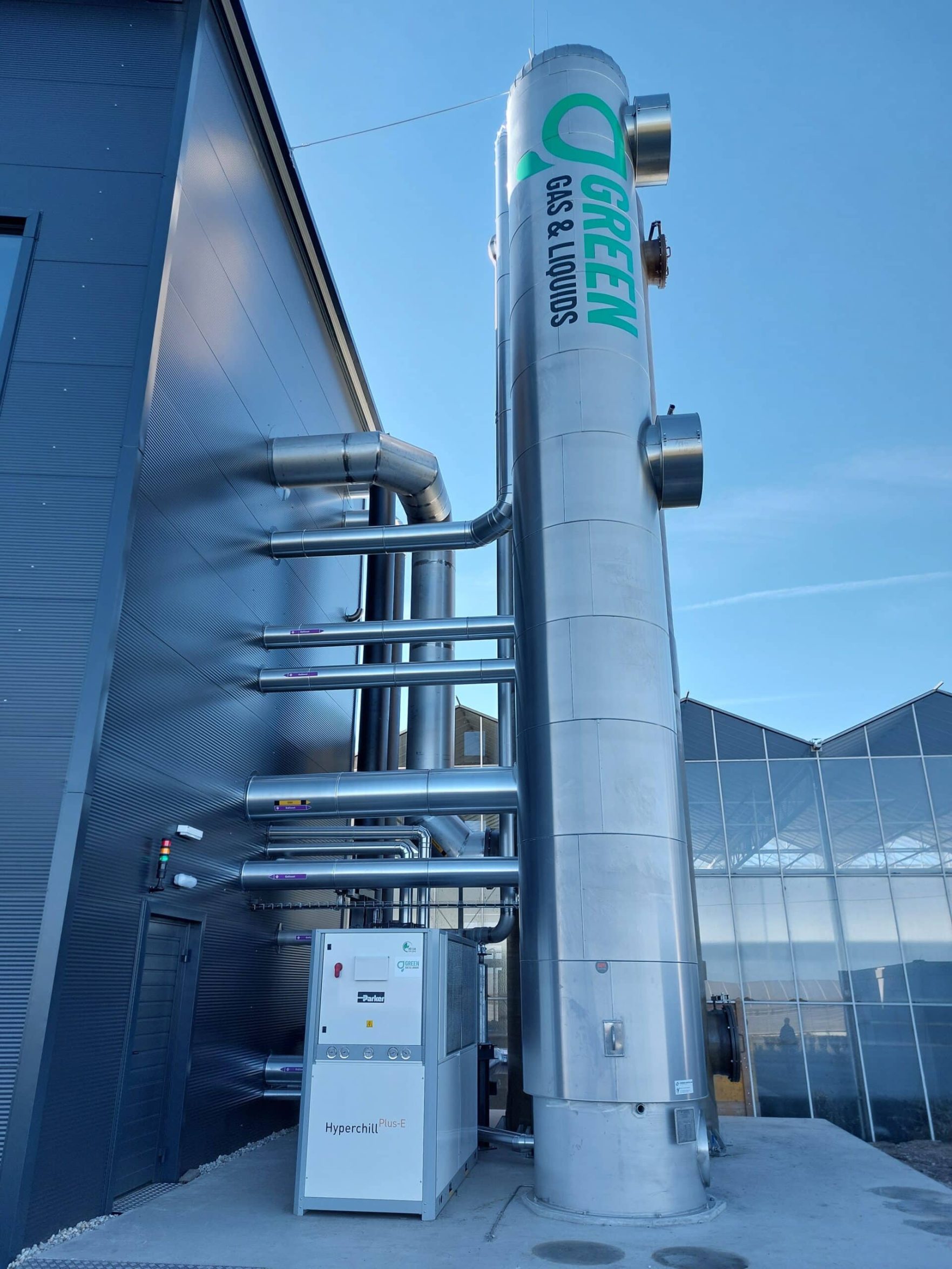
Green Gas & Liquids has reached a major milestone at Merschl Gartenbau GmbH in Vienna. On 7 November 2025, our Galloxol® system captured 1.8 tonnes of CO₂ per hour from biomass flue gases — and the boiler was not yet running at full capacity. The Austrian tomato grower can now produce its own CO₂ on-site, without relying on external supply.
This is GGL’s first installation in Austria, and another proof point for on-site CO₂ capture in European greenhouse horticulture.
From biomass flue gas to greenhouse CO₂ — with heat recovery included
Merschl Gartenbau grows tomatoes year-round in Vienna. Until recently, the business depended on externally supplied CO₂ — an input that is becoming both more expensive and less reliable. Now, the Galloxol® system captures CO₂ directly from the biomass boiler’s flue gases, purifies it, and makes it available for greenhouse enrichment.
In addition, GGL integrated a heat recovery system into the installation. As a result, residual heat from the flue gases — which would otherwise be wasted — is now reused on-site. This means the system cuts emissions, removes dependence on external CO₂, and lowers energy costs at the same time.
Galloxol®: why it is safer than amine-based CO₂ capture
The Galloxol® technology at the core of this project was designed specifically to improve on conventional amine-based capture systems. Managing Director Laleh Hosseini explains: “Galloxol® is safer, more environmentally responsible, and more cost-effective than traditional alternatives. Because the solvent is biodegradable and has no vapour pressure, the process releases no harmful emissions. That makes it especially well suited to greenhouse and agricultural settings.”
In a greenhouse environment, this matters directly. Food safety and product quality standards are strict. Consequently, the fact that the captured CO₂ contains no solvent traces gives growers greater confidence in what they are dosing to their crops.
Delivered in 54 weeks: from contract to first capture
The project moved quickly. From the moment the contract was signed, GGL completed engineering, procurement, construction, installation, and commissioning in just 54 weeks. Construction started in spring 2025, and the first successful CO₂ capture test followed in November.
Laleh Hosseini: “We are proud of our team and partners for delivering this in such a short timeframe. Furthermore, this milestone shows that CO₂ capture can be both sustainable and commercially viable, even at smaller industrial scales.”
The full system is on track to supply CO₂ to Merschl Gartenbau’s 8 hectares of tomato greenhouses by the end of 2025.
Part of a growing European reference base
The Vienna project is the latest addition to a reference base that now spans five countries. GGL’s Galloxol® technology has been in commercial operation since 2019, starting with DES B.V. in Sirjansland, the Netherlands. Since then, installations have followed at Wijnen Crops in Egchel (2021), FNXP LNG in Italy (2022), and EmsFlower in Germany (2022). Each project has added operational experience and made subsequent deliveries faster and more reliable.
Moreover, as external industrial CO₂ becomes scarcer and more expensive across Europe, the financial case for on-site biogenic capture grows stronger. Growers who act now are building a long-term cost and supply advantage.
Considering on-site CO₂ capture for your greenhouse or industrial operation? We would be glad to explore the options with you.
Source: Thijmen Tiersma, GroentenNieuws.nl, 26 November 2025. Read the original article (Dutch).
Share
Share this article
Share this article on your favorite social media site or to a colleague.
News
You might also like these articles


Calculator
Calculate your expected CO2 decarbonization
"*" indicates required fields
